
10 Website Redesign Checklist Tips for Better SEO and Performance
A successful website redesign can completely transform your online presence. In today’s digital world, your website is often the first interaction customers have with your business. If your website looks outdated, loads slowly, or is difficult to navigate, visitors may leave within seconds. A well-planned redesign improves user experience, strengthens your brand image, increases conversions, and helps your website rank better in search engines.
However, redesigning a website is not only about changing colors, fonts, or layouts. It requires strategic planning, SEO optimization, content improvement, and technical updates. Without a proper process, businesses can lose valuable traffic and search engine rankings. This complete website redesign checklist will help you understand every important step required for a smooth and successful redesign.

Why Website Redesign Is Important
A website redesign is important because user expectations and digital trends continue to evolve. Visitors expect websites to load quickly, work perfectly on mobile devices, and provide a smooth browsing experience. If your website does not meet these expectations, your competitors may attract your audience instead.
A modern website redesign helps improve usability, website speed, security, and overall functionality. It also gives businesses an opportunity to update branding, improve content quality, and optimize pages for search engines. Companies that regularly improve their websites often see better customer engagement, higher conversion rates, and stronger online visibility.
Define Clear Goals Before Starting
Before beginning any website redesign project, it is important to define clear objectives. Many businesses redesign their websites without understanding what they actually want to achieve. As a result, they spend time and money without seeing meaningful improvements.
Your goals may include generating more leads, improving SEO performance, increasing online sales, or creating a better mobile experience. Some businesses redesign their websites to strengthen their brand identity, while others focus on improving website speed and user engagement. When goals are clearly defined from the beginning, every design and content decision becomes more effective and purposeful.
Analyze Your Current Website Performance
One of the most important parts of a website redesign is analyzing your current website. Understanding what already works can prevent you from losing valuable traffic and high-performing pages.
Review your website analytics carefully and identify which pages receive the most traffic, which keywords perform well, and where visitors spend the most time. It is also important to identify weak areas such as high bounce rates, slow-loading pages, outdated content, or broken links. This information provides valuable insights that can guide your redesign strategy and help you make smarter decisions.
Read More: Website Redesign Checklist for Better SEO and Performance
Improve Website Structure and Navigation

Website navigation plays a major role in user experience. Visitors should be able to find information quickly and easily without confusion. During the redesign process, focus on creating a clean and organized website structure.
Menus should remain simple and easy to understand. Important pages must be accessible within a few clicks, and categories should follow a logical structure. A well-organized navigation system not only helps users but also improves search engine crawling and indexing. Search engines prefer websites that are structured clearly because they can understand the content more effectively.
Focus on Mobile-Friendly Design
Mobile responsiveness has become essential for every modern website. A large percentage of internet users browse websites using smartphones and tablets, which means your redesigned website must perform smoothly on all screen sizes.
A responsive website automatically adjusts layouts, images, and text according to the device being used. Buttons should be easy to click, fonts should remain readable, and pages should load quickly on mobile networks. Mobile optimization also directly affects SEO because search engines prioritize mobile-friendly websites in search results.
Optimize Website Speed and Performance
Website speed is another critical factor that should never be ignored during a website redesign. Slow websites frustrate users and often lead to higher bounce rates. Even a delay of a few seconds can reduce conversions and negatively impact customer satisfaction.
Improving speed involves optimizing images, reducing unnecessary code, enabling caching, and choosing reliable hosting services. A fast-loading website improves the overall user experience and helps search engines rank your website more favorably. Modern users expect websites to load almost instantly, so performance optimization should always be a top priority.
Protect Your SEO During the Redesign
One of the biggest risks during a website redesign is losing SEO rankings. Many businesses accidentally remove important pages, change URLs without redirects, or ignore on-page SEO elements. These mistakes can significantly reduce organic traffic.
To avoid SEO problems, preserve important URLs whenever possible and create proper 301 redirects for pages that change. Meta titles, descriptions, headings, and image alt text should also remain optimized. Internal linking should be maintained carefully, and an updated XML sitemap should be submitted after launch.
SEO should be considered throughout the entire redesign process rather than being added at the end. A redesign that follows SEO best practices can actually improve rankings and increase organic traffic over time.
Refresh and Improve Website Content
A website redesign is the perfect opportunity to improve your content. Outdated information, weak messaging, and poorly written pages can reduce engagement and hurt SEO performance.
Updating content helps ensure that your website remains valuable and relevant to visitors. Rewrite pages that lack clarity, improve readability, and naturally include important keywords related to your business. High-quality content builds trust with visitors and increases the chances of conversions.
Adding engaging visuals, updated statistics, and stronger calls-to-action can further improve user engagement. Modern websites should combine attractive design with informative and useful content.
Strengthen Website Security
Website security is another important part of a successful redesign. Visitors expect websites to protect their personal information and browsing experience. Search engines also prefer secure websites and may warn users about unsafe pages.
Installing an SSL certificate, updating plugins, and using strong security measures can help protect your website from threats. Regular backups and security monitoring are also important to prevent data loss and maintain website stability. A secure website builds trust and improves credibility among users.
Test Everything Before Launch
Testing is one of the most important stages of any website redesign project. Even a visually impressive website can fail if technical issues are ignored. Before launching the redesigned website, every feature should be tested carefully.
The table below highlights the key areas that should be checked before launch:
| Testing Area | What Should Be Checked |
|---|---|
| Mobile Responsiveness | Layout and usability on all devices |
| Website Speed | Loading time and performance |
| Navigation | Menus, buttons, and internal links |
| SEO Elements | Meta tags, redirects, and indexing |
| Forms and Features | Contact forms and user interactions |
| Browser Compatibility | Functionality across different browsers |
Careful testing helps identify problems before users encounter them, ensuring a smoother launch experience.
Monitor Performance After Launch
Launching the redesigned website is only the beginning. After launch, it is important to monitor performance closely and identify any issues quickly.
Track important metrics such as traffic, bounce rates, keyword rankings, and conversion rates. Monitoring user behavior can reveal areas that still need improvement. Some SEO fluctuations are normal after a redesign, but regular monitoring helps ensure long-term success.
Continuous optimization allows businesses to improve their websites over time and adapt to changing user expectations and search engine updates.
Common Website Redesign Mistakes to Avoid
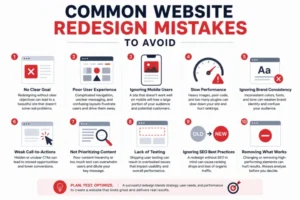
Many businesses make avoidable mistakes during the redesign process. Ignoring SEO, removing important pages, using complicated navigation, or failing to optimize for mobile users can hurt website performance significantly.
Another common mistake is focusing only on design while neglecting functionality and user experience. A beautiful website is ineffective if users cannot navigate it easily or complete important actions. Proper planning, testing, and optimization are essential for avoiding these issues.
Conclusion
A professional website redesign is much more than a visual upgrade. It is an opportunity to improve performance, enhance user experience, strengthen SEO, and increase business growth. By following a structured redesign checklist, businesses can create websites that are modern, user-friendly, and optimized for search engines.
From defining goals and improving navigation to protecting SEO and testing performance, every step plays a crucial role in the success of the redesign. A carefully planned website redesign not only improves appearance but also creates better experiences for visitors and stronger results for businesses.
FAQs
1. How often should a website be redesigned?
Most businesses redesign their websites every two to three years to maintain modern design standards and improve performance.
2. Can website redesign improve SEO rankings?
Yes, a properly optimized website redesign can improve SEO rankings, website speed, and user experience.
3. Why is mobile responsiveness important in website redesign?
Mobile responsiveness ensures your website works smoothly on smartphones and tablets, improving both user experience and SEO.
4. What is the biggest mistake during a website redesign?
Ignoring SEO and failing to set up proper redirects are among the most common and harmful redesign mistakes.
