
7 Powerful Website Speed SEO Tips to Boost Rankings
In today’s digital world, users expect websites to load quickly. If a website takes too long to open, visitors often leave before even viewing the content. This not only affects user experience but also impacts search engine rankings. Website speed has become one of the most important ranking factors in modern SEO strategies.
A fast-loading website improves engagement, increases conversions, and helps search engines crawl pages more efficiently. On the other hand, a slow website speed SEO can reduce traffic, increase bounce rates, and negatively affect online visibility. Understanding the connection between website speed SEO and search performance is essential for every website owner.
In this guide by worldtricks4u, you will learn how website speed impacts SEO, why it matters for rankings, and how to improve your website performance effectively.

What Is Website Speed in SEO?
Website speed refers to how quickly a webpage loads and becomes fully usable for visitors. It includes several performance factors such as server response time, image loading, page rendering, and overall site responsiveness.
Search engines like Google prioritize websites that offer better user experiences. Since users prefer fast websites, Google considers speed as an important ranking signal. This is why website speed SEO plays a critical role in improving search engine visibility.
A fast website not only keeps users happy but also helps search engines understand and index content more effectively.
Read More: SEO Mistakes to Avoid for Better Rankings | worldtricks4u 2026
Why Website Speed Matters for SEO
Better User Experience
User experience is directly connected to website speed. Visitors expect pages to load within a few seconds. If a website loads slowly, users may become frustrated and leave immediately.
Fast websites create smoother browsing experiences and encourage users to stay longer. This improves engagement metrics such as average session duration and page views, which can positively influence SEO performance.
Lower Bounce Rate
Bounce rate measures how quickly users leave a website speed SEO after visiting a page. Slow-loading pages often result in higher bounce rates because users lose patience.
Google interprets high bounce rates as a sign that the website may not be providing a good experience. Improving website speed SEO can help reduce bounce rates and keep users engaged with your content.
Improved Search Engine Rankings
Google officially uses page speed as a ranking factor. Websites that load faster are more likely to rank higher compared to slower competitors.
While content quality remains essential, speed optimization gives websites an additional advantage in search results. Faster websites can also improve crawling efficiency, allowing search engines to index pages more effectively.
How Website Speed Affects SEO Performance
Faster Crawling and Indexing
Search engine bots have limited time to crawl websites. Slow website speed SEO consume more crawl resources, which may reduce the number of pages indexed.
When your website loads quickly, search engine crawlers can access more pages efficiently. This improves index coverage and helps new content appear faster in search results.
Better Mobile SEO

Most internet users browse website speed SEO through smartphones. Google uses mobile-first indexing, meaning it primarily evaluates the mobile version of a website for rankings.
A slow mobile website can significantly harm SEO performance. Mobile users expect fast loading speeds, especially when using slower internet connections.
Optimizing mobile speed is essential for successful website speed SEO strategies.
Increased Conversion Rates
Website speed not only affects SEO but also impacts conversions and sales. Studies show that even a one-second delay in loading time can reduce conversion rates.
Fast website speed SEO create trust and improve user satisfaction, leading to higher engagement and better business results.
Common Causes of Slow Website Speed
Several factors can reduce website performance and affect SEO rankings.
| Common Speed Issue | Impact on SEO | Solution |
|---|---|---|
| Large image files | Slower page loading | Compress and optimize images |
| Poor hosting service | Website downtime and delays | Use reliable hosting |
| Too many plugins | Reduced performance | Remove unnecessary plugins |
| Unoptimized code | Slow rendering speed | Minify CSS and JavaScript |
| Excessive redirects | Increased loading time | Reduce redirect chains |
Identifying and fixing these issues can significantly improve website speed and search performance.
Important Website Speed Metrics
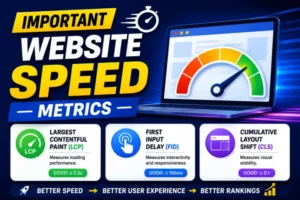
Largest Contentful Paint (LCP)
LCP measures how quickly the main content of a webpage loads. A good LCP score improves user experience and SEO performance.
First Input Delay (FID)
FID measures how quickly a website responds when users interact with it. Faster interaction times create better usability.
Cumulative Layout Shift (CLS)
CLS evaluates visual stability during page loading. Pages that shift unexpectedly while loading can frustrate users.
These Core Web Vitals are essential parts of modern website speed SEO optimization.
Best Ways to Improve Website Speed SEO
Optimize Images
Large images are one of the most common causes of slow websites. Compressing images without reducing quality can significantly improve loading speed.
Use modern image formats like WebP and ensure images are properly sized for different devices.
Use Fast Web Hosting
Your hosting provider directly affects website performance. Cheap or overloaded hosting servers often slow down websites.
Choose a reliable hosting provider with good uptime, fast servers, and optimized performance for better SEO results.
Enable Browser Caching
Browser caching stores website files on users’ devices, reducing loading times for repeat visitors.
Caching improves performance and creates a smoother user experience.
Minify CSS and JavaScript
Unnecessary spaces and code elements increase file sizes. Minifying CSS, JavaScript, and HTML files reduces loading times and improves performance.
Use a Content Delivery Network (CDN)
A CDN distributes website content across multiple global servers. This reduces loading time by delivering content from the nearest server location.
CDNs are especially useful for websites with international audiences.
Reduce Plugins and Scripts
Too many plugins can slow down your website significantly. Remove unused plugins and avoid unnecessary third-party scripts whenever possible.
Keeping your website lightweight improves both speed and SEO.
Mobile Optimization and Website Speed SEO
Mobile optimization is now more important than ever. A website that performs well on desktops but poorly on mobile devices can lose rankings.
To improve mobile website speed:
- Use responsive design
- Compress mobile images
- Avoid intrusive pop-ups
- Reduce unnecessary animations
- Optimize fonts and layouts
A mobile-friendly website enhances user experience and improves search engine performance.
Website Speed and Core Web Vitals
Google introduced Core Web Vitals to measure real-world user experience. These metrics focus on loading performance, responsiveness, and visual stability.
Improving Core Web Vitals can boost both SEO rankings and user satisfaction. Websites that meet Google’s performance standards are more likely to perform better in competitive search results.
Tools to Test Website Speed
Several free tools can help analyze website performance:
- Google PageSpeed Insights
- GTmetrix
- Pingdom Website Speed Test
- Google Search Console
- Lighthouse
These tools provide detailed reports and suggestions to improve website speed SEO.
Conclusion
Website speed has become a critical factor in modern SEO. A fast-loading website improves user experience, reduces bounce rates, increases conversions, and helps achieve better search engine rankings.
Ignoring website speed can negatively impact traffic and overall online performance. By optimizing images, improving hosting, reducing unnecessary scripts, and focusing on mobile performance, you can build a faster and more SEO-friendly website.
At worldtricks4u, we believe that investing in website speed optimization is one of the smartest long-term SEO strategies for sustainable online growth.
FAQs
1. Does website speed affect SEO rankings?
Yes, Google considers website speed as an important ranking factor for both desktop and mobile searches.
2. What is a good website loading speed?
A website should ideally load within 2–3 seconds for the best user experience and SEO performance.
3. How can I check my website speed?
You can use tools like Google PageSpeed Insights, GTmetrix, and Pingdom to test website speed.
4. Why is mobile speed important for SEO?
Google uses mobile-first indexing, so slow mobile websites can negatively affect rankings and user experience.
